


Introduction
On Yen there are many religions with very different beliefs. Some are limited to specific species or regions, while others have spread farther.
Cult of Apéthantos
Apéthantos was a duke of hell in the service of Belial, with an insatiable craving for power.
He was cast out of hell after abusing his might.
Next he managed to set himself up as a deity on Yen, a living 'god-king', ruling through strength, cunning and an evergrowing army of undead.
At his height his realm spanned Hashi, Shihoshi, north Techlaltho and most of the Siir.
Because of his growing threat, an unlikely coalition of weka, wekalai and simi, possibly with help of Ordh'inagei, united against him and defeated him in the War of the Black Sky.
Nowadays, the cult is shattered and the whereabouts of the devil are unknown.
In dark corners of Yen there are still worshipers, hoping to reinstate him and gain a good position for themselves in the process.
Dzartakshüt
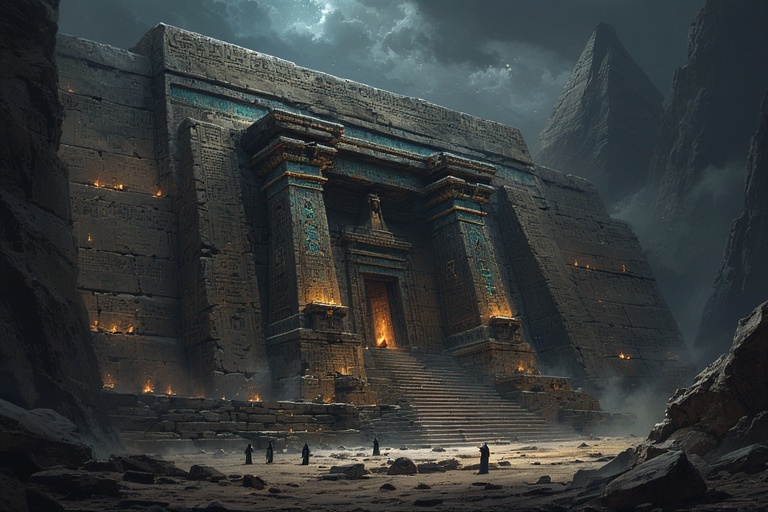
The religion of the Dzartak theocracy is shrouded in mystery, as it is full of complicated rituals that are open only to believers.
Outsiders who try to spy are quickly detected.
Some are expelled, but most are killed or used as sacrifice.
Supposedly the adherents of Dzartakshüt worship the ultimate primal being, from which all intelligent species of Yen sprang.
Some say it is a giant behir, others a lamia or a snakelike demon.
It is rumored to reside on Yen itself, somewhere in the vast dungeons under the city of Zymakh,
where slaves and prisoners are sacrificed to it, though no outsider has ever confirmed this.
It is known that the worship of the Dzartak god is orchestrated by a priesthood, a caste of its own, who govern the country.
Priesthood is hereditary, but requires long and arduous training.
Not all acolytes attain full priesthood.
Some are demoted to the rank of common citizen, others are rumored to end up as sacrifices.
Religious ceremonies, including sacrifices, are performed in temples.
Each settlement where Dzartakshüt is present has a temple, a strong grim building made of stone.
In villages they are small, in towns or cities grand affairs.
Each temple is the center of its settlement.
Religious ceremonies are aligned with the movement of Yen's suns.
According to some this includes not only Yai, Tsuki and Taisku, but also a fourth sun which is dark and cannot be seen by normal means.
Conjunctions and contra-conjunctions determine holy days and thereby major religious ceremonies.
Ggigbete
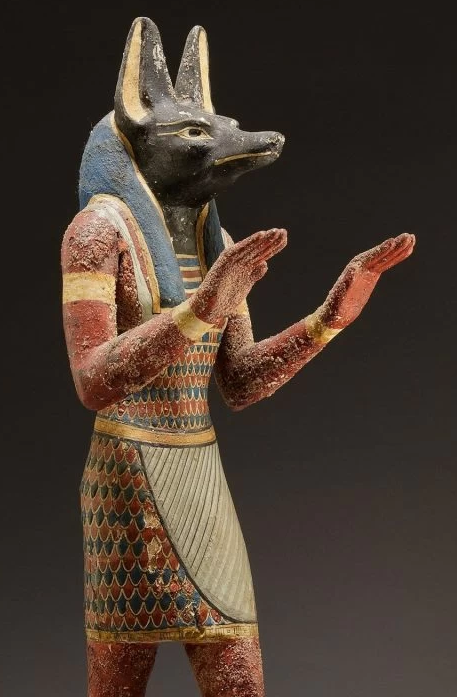
The home religion of Nkala has the concept of transference at its core.
The people believe that by eating animals, they can take on animal attributes, like strength, speed, camouflage or another boon.
This transference is temporary, but according to its adherents repeated consumption can make such a transferred quality permanent.
Transference of attributes is not limited to animals.
Sapient species can be eaten too, even members of the same species, leading to cannibalism, though this is rare.
Advanced practitioners do not limit themselves to attributes, they can change to animal shape and back to simi.
Sometimes transference works both way, with animals taking on simi attributes like manual dexterity or intelligence.
This is a kind of 'trade' between simi and animal, though usually transfer is a one-way.
Some state that simi can possess animals, taking over their mind, and animals can do the same with simi.
However, the ggigbete practitioners deny these claims, refusing to endorse a simple body-plus-mind paradigma.
They see intelligence as just another attribute.
There is some kind of transmutation magic involved in ggigbete.
Possibly lycanthropy plays a role too, though religious transference is not bound to Yen's moons.
Some scholars claim that this magic came into being during the Age of Magic, but the believers state that their mastery of transference has always been with them.
There are no gods or priests in this religion.
Every practitioner can become a "mlajaja", a 'devourer', though some are (much) better at it than others.
True transference requires more than just eating flesh, involving long and complex rituals that need to be learned and mastered.
In D&D terms it is a separate skill.
In ggigbete religious imagery man-animal hybrids are common, like men with the body of a snake, wings like a bird or a tail; or animals with simi heads and/or arms.
In Nkala, the home ground of ggibete, centaurs, chimerae, flying snakes, harpies, hippogriffs, manticores, mermaids, minotaurs, nagas or pegasi are not considered strange at all.
Neither is the range of man-animal hybrids limited to the creatures in the monster manual.
For example there are reports of goat-men, walking seals and even gecko-men.
Some ggigbete practitioners consider wekalai, half weka and half human, the ultimate shape-changers,
while others scoff at them for not being able to change shape.
Issai
This is the only monotheistic religion on Yen.
It was founded by the prophet Tawagoto in Yamazui in 785 HC.
His teachings state that there is only one god, named Issai, who is the one, the whole.
Everything and everyone on Yen is part of Issai.
Originally Issai was single, but at the beginning of time the god has fractured into the multitude that is now Yen.
Followers of the faith aim to make Issai whole again.
To achieve this, intelligent beings must acknowledge their position as fragment,
and non-intelligent animals, plants, objects, places and anything else must be dedicated to the god.
Followers try to make Issai's wholeness tangible by enforcing uniformity in language, appearance, food, behavior, organization or anything else that can be made more uniform.
In areas where the faith is influential they create rigid political and cultural systems.
There is no room in Issai for other religions, so conflicts with those are frequent, fierce and often violent.
Kodō
The 'Ancient Way' is the traditional belief system of Yamato.
It is an animistic religion, similar to Earth Japanese Shintō, but with differences.
Its core belief is that everything and everyone is empowered by "kami", spirits.
There are spirits for natural phenomena like mountains, rivers and forests, but also for individual plants and animals,
as there is no clear distinction between groupings and individuals.
Places, buildings and objects have kami too.
Each member of a sapient species is thought to have / be a kami also.
Unlike many other religions, kodō does not make a clear distinction between life, death and afterlife.
Like childhood, maturity and old age, these are seen as different stages in the existence of the kami.
Believers think that people come from nature and sooner or later are returned to it.
Thus, ancestor kami exist, though they are no longer the same as during life.
It is common not to bury or cremate the dead, but to let carnivores devour them.
This is done only in designated spaces; bodies are never left to rot.
Adherents of kodō see themselves as part of nature, with powers both greater and lesser than those of other kami.
Like all animists, they try to influence the kami with offerings, prayer, festivities and erecting statues and temples.
This should be called worship as the people do not consider the kami to be superior to themselves, just different.
They seek their help, or try to calm angered kami.
There are no deities in kodō, though some kami are larger and more powerful than others.
For example, some consider the Umi as a kami, which can be considered a god, though without a clear personality like in the lively yokani pantheon.
Also, there is no formal priesthood; anyone can set him/herself up as a priest.
There are professional priests who assist in divination, abjuration, pleading and other interactions with the kami, but they are not a separate profession or caste.
Interaction with kami takes place in nature, at home and in temples.
Hardanger giants
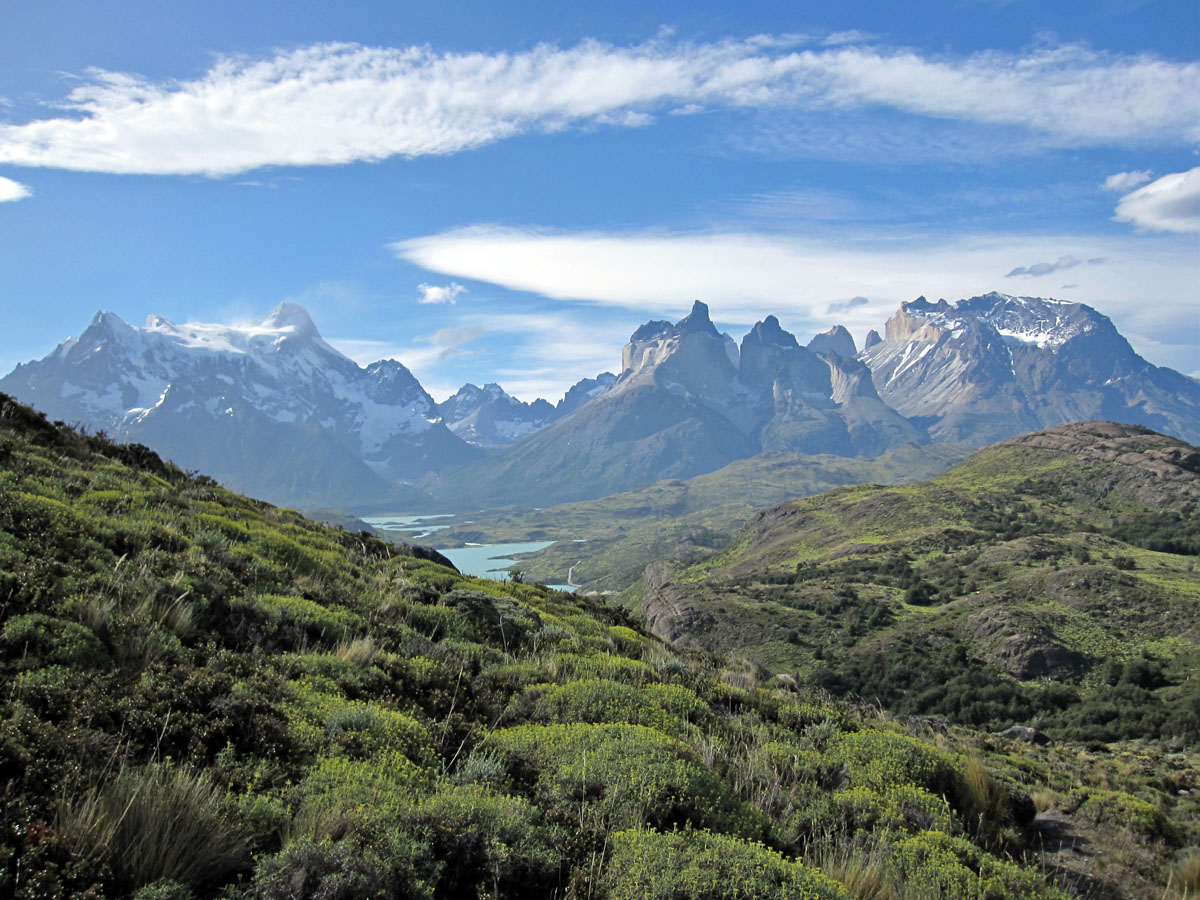
The people of the Hardanger mountains, the highest on Yen, worship all peaks, especially the tallest ones, as gods. They pray and sacrifice to them to plead for benign weather. This religion is animistic and worships rivers and groves too, but is more straightforward than for example kodō. The believers consider other religions too fanciful and presumptuous when it comes to god or spirits. Nature spirits rule the land and the weather; mountains tower over all. Iihh are considered sacred beings, a status that they happily accept.
Byrnal titans
The Byrnall have copied the faith of the people of the Hardanger. Instead of mountains, they worship islands. As many Byrnal islands are peaks that jut out of the water, mostly this amounts to the same thing. In addition, the envision the sea as a separate god, one who is very powerful yet fickle.
Nairukyō
According to the teachings of Nairu of the Reaching Hand life as the people of Yen know it is a finite, temporary stage, to be followed by a second, final, infinite afterlife on another world.
In this view, a whole life is a kind of youth stage, preparing one for the adult stage that comes next.
All efforts of the living should be aimed at improving their second life.
Nairu came from the north of Yamazui.
From there, the faith has spread, mainly to the eastern shores of the Egerr, Siir and the Hesha valley.
Nairu himself has left for the afterlife long ago.
Some worship him as a god, others as a prophet.
Hara-Nairukyō
The original teachings of Nairu stress the need learn, grow wise, to detach oneself mentally and eventually physically from the first life,
in order to transcend to the second life smoothly.
Today it is professed by a small group of ascetics, monks and sages.
Some withdraw into monasteries that are devoted to the religion.
The monks there try to detach from normal life.
The monasteries have strict rules to strengthen the monks in their pursuits.
Despite that strictness, there is considerable variation from one monastery to another.
This has given rise to a class of "rohei", monks who wander from one monastery to the next, gathering insights.
Taka-Nairukyō
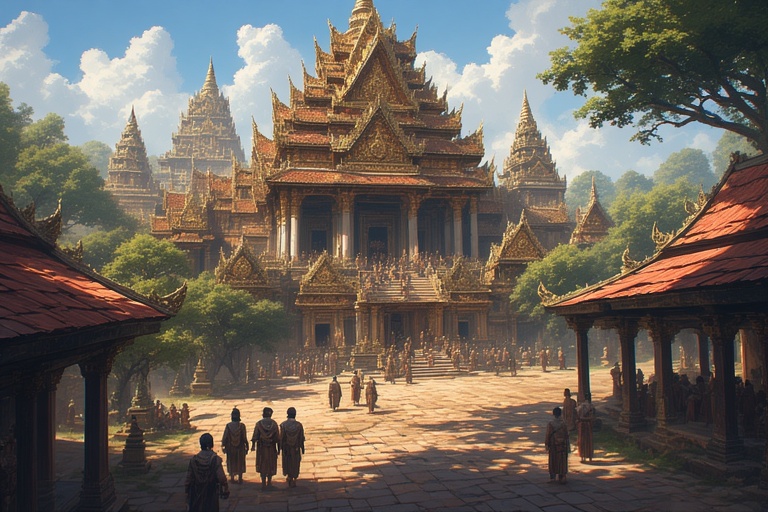
The most widespread and popular Nairukyō-school is the most worldly. In their opinion there is not much difference between life and afterlife, except that the latter is permanent. Thus, a smart believer tries to make sure to come prepared. Its followers accumulate as much power and especially wealth as they can, to be transferred with them into the afterlife upon their death. Taka-Nairukyō priests mediate in this and have grown very rich and mighty in the process.
Ju-Nairukyō
Followers of this branch of Nairukyō disdain worldy detachment or riches. They preach placidity, harmony and good deeds as the way to a proper afterlife, hoping that that will be equally peaceful.
Tsunochi
This sect is the antipode of Nairukyō. Its members seek to evade the afterlife and life forever. Some seek a magical substance called "sasei", which is reputed to be able to heal all wounds and prevent aging. Others pursue the magic arts themselves, aiming to become a lich, after the example of Gojota, the first ever lich on Yen. Some have turned to vampirism.
Ordh'inageian
This cult worships Ordh'inagei, the sentient Wirrash swamp being, as a god. Its members claim it is not only the wisest being in the world, but also its creator, having lifted Yen out of the Umi to allows other beings to live on. They also claim that each sentient being must prove itself worthy. This claim seems to be backed by reality, as Ordh'inagei only very rarely communicates with other beings and the members of the cult are always being hunted by the weka and wekalai, making survival difficult.
Tangre
The faith of the nomads of the Yrgiz steppes is simple. They worship a small number of major gods, a larger number of lesser gods and countless nature spirits. The major gods and goddesses are:
- Bailan: creator of the world
- Apra: mother goddess, who brings gold and silver and gives fertility
- Ipye: horse god, who gives speed and freedom
- Savak: god of war, strength and bravery
There is no hierarchy in the pantheon. People worship deities that they feel are important to them, depending on the situation.
An important concept in Tangre is "yuy", which means something like luck or favor of the gods. Some people have more yuy than others and fare better in life. They tend to be chosen as leaders, in the hope that some of the benevolence rubs off on others too. However, yuy is a fickle thing; lucky people can become unlucky or the other way around, for reasons that are not always clear. Such changes prompt for a change in leadership. The nomads of the steppes do not switch leaders overnight. Reputations can be built up and worn down, never turn upside down in an instant.
Ugokuchi
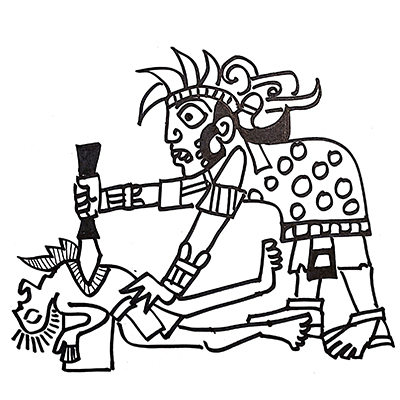
'Moving blood' is a religion that is found in Yamazui.
There are minor variations, but the central doctrine is that the gods are responsible for the flow of the gold and silver, the 'blood of the ground', especially their upwelling,
and those gods should be paid by letting the blood of living creatures flow back into it.
There are parallels between ugokuchi and the religious beliefs of several Earth-medieval Mesoamerican cultures.
Like those, the practitioners of ugokuchi build pyramids, which represent hills and ultimately the ground.
Sacrifices are done at the top, the blood flowing down back to the soil.
Blood sacrifices are the main mechanism through which worshipers try to honor the gods and ask favors from them.
The main deities are:
- Ketsu-aru: god of knowledge, learning, art, crafts
- Itsuchitori: god of war, sacrifice, rebirth
- Kouku: goddess of rain, rivers, fishing and agriculture
- Amasku: god of time
- Iyana: god of healing
- Yoshue: goddes of love, fertility
- Yaike, Tsukine, Taiskune: the three sun goddesses
Ketsu-aru is considered to be the main god, but there is no hierarchy among the deities.
Shizukachi
A sect that split off from the main Ugokuchi religion.
Followers of Shizukachi state that the flows in the Earth are powered by the gods, yet they do so unconsciously, while sleeping.
Should the gods awaken, then their stirring will disrupt the blood of the ground and disaster will strike.
The gods must be kept in slumber through blood sacrifices.
Shizukachi is considered heresy by practitioners of Ugokuchi, while on the other side of the religious division opinions are reversed.
Uhemet
Telgu religion is basically ancestor worship.
The telgu believe that when one of them dies, he/she is not vanquished but transcends to another level of existence, as a spirit.
Those who were powerful, wise or living during life remain so once dead; likewise wastrels, misfits or villains stay at the bottom.
These spirits, high and low, can affect the living any many ways, blessing or cursing people, places and events.
Unlike some other religious no such powers are attributed to animals or nature.
The telgu state that influence requires intelligence, not instinct.
Telgu try to obtain favors from their ancestors, not through prayer or by sacrifice, but by communicating with them.
To be able to talk to the dead, intoxication through alcohol is necessary, the more, the better.
During religious ceremonies telgu drink themselves drunk, which makes them clumsy and slow,
though they claim that on spiritual level they reach great heights.
Dead telgu are, when possible, mummified and stored in underground catacombs.
They are buried with grave gifts to help them in the afterlife.
When a religious festival takes place, these are taken out and feted, to the merriment of all.
To miss out on a burial, for instance when the body of a dead telgu is lost or utterly destroyed, is considered to be a great pity,
as it makes the connection between the dead and the living much more difficult.
This is why the telgu go to great lengths to retrieve their dead.
Because of the sometimes lavish grave gifts, grave robbers are active in the lands of the telgu.
Most are from other races but some are telgu themselves.
Robbing graves is considered a heinous crime by followers of uhemet.
The penalty is death without burial, by cremation or another equally destructive method.
Vesemei
Vesemei has its roots in ancient ancestor worship, but has grown beyond that.
Its core belief is that exceptional people can change the world, i.e. change its nature, elevating it to a new stage.
Examples of these "vesemi" are Redface Kanesan, who is supposed to have invented iron smithing;
Great Nurusu, the first simi mariner to cross the sea from Yamato to Kaigan
and Noboru of the Clouds, the philosopher who brought magic to Yen by invoking the first wish spell.
Each of these, and others, are considered to have risen from manhood to godhood.
These men-turned-gods are honored and worshiped.
Common people pray and sacrifice to them for some minor change in their lives, to dispel disease or some twist to lift their fortunes.
Others, in true vesemei style, take their fate in their own hands and try to better themselves, maybe even to become vesemi themselves.
There is a small priesthood who try to seek out new divine "vesemi" among these aspirants and assist them in their endeavors.
Some equate the deeds of mages with the acts of the vesemi, but the vesemei creed strongly disagrees with that.
It calls vesemei changes pure and natural, condemning magic als alien and sometimes even evil.
Many vesemei priests are hostile to mages.
Vesemei originated in Yarega and still is the dominant religion there.
There are also many adherents in Shihoshi.
Yectenehuatl
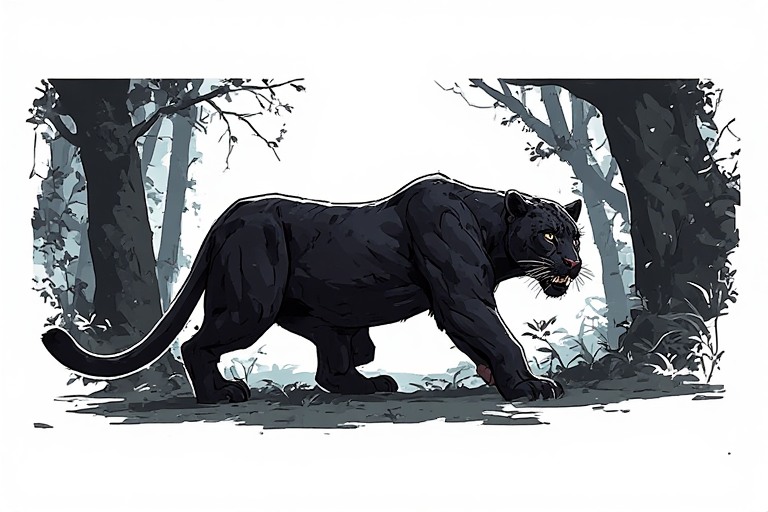
The weka and most of the wekalai worship just one god: Yectenehuatl. He or she - the gender is not clear - is the ultimate feline hunter: silent, alert, fast and strong. He/she has given the weka the gift of the hunt. They do not worship him/her like believers of many other religions do, seeking favors, as they claim he/she already has given them such. Rather, they honor and acknowledge Yectenehuatl through words of praise and the sacrifice of the blood of prey.
Yokani pantheon
The yokani worship a whole pantheon of gods, who are quite humanoid, just as the Greek and Norse pantheons on Earth.
They are not above vanity, jealousy and strife, but are attributed supernatural powers.
The main gods and goddesses are:
- Ōbotai, the great mother: goddess of fertility, birth, family, fertility
- Kurona, the golden One: goddess of gold and warmth
- Ganedoke: god of smithing
- Kakaze: goddess of love, trickery, strife and drinking
- Shi, the dark one: god of death
- Utan: god of music and poetry
- Fubu: god of luck, wealth and happiness
- Yahata: god of war
Ōbotai is the head of the pantheon, mother of the other gods and goddesses.
Prayers and especially sacrifices to them, to beg favors, are common.
Priests mediate between yokani and their deities.
Each priest is dedicated to a single god or goddess.
Before engaging in rituals, priests must purify themselves.
This means cleaning, abstention from alcohol, sex, music and dance, all for at least a week.
Only when pure can they start interacting with the deities.
If the purity is broken, the purification process must start anew.