


Introduction
The physics, and also chemistry, biology and other physical matters of Yen are largely similar to those of Earth, yet there are significant differences too.
Metals
Silver and gold are noble metals on Earth, but they are perishable on Yen, though precious nonetheless. Each has a special attribute, see below. However, dug up from the ground and exposed they deteriorate. They dull and blacken, their attribute wanes, and eventually become friable and inert.
Gold
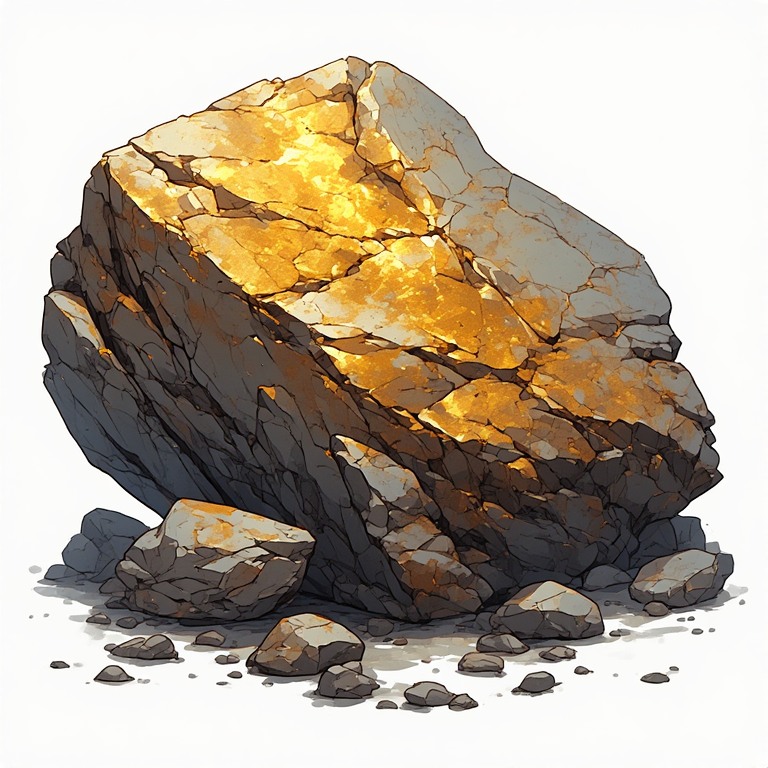
Gold is called "kin", and also "kurogane", 'yellow metal' in Go. When dug up, it does not just reflect light but shines by itself, of course with a golden color. Its light is soft and warm, literally, so it is used as a way of warming without burning things. Gold deteriorates under the influence of other light, slowly in sunlight, faster in moonlight, most rapidly in darkness. In a cycle of light and dark it may last a few weeks or so.
Silver
Silver is called "gin", and also "shiragane", 'white metal' in Go. Like gold, silver shines by itself, of course with a silvery color. Its light is brighter than that of gold, so it is a better light source, though it is not warm. It attracts water, a little from the ground but most of it from the air: rain or fog. Exposed to water itself it deteriorates, proportionally to the wetness. In arid conditions it can last weeks, slowly pulling in water, while in rain it is gone in only hours, or submerged in just minutes.
Gold is more important than sunlight (see below) for warming the surface of Yen. Likewise, silver is essential for flora, being weightier than wind, temperature or mountains in bringing water to the land. Therefore, these two 'metals' are highly valued on Yen, despite their limited shelf life. At times when they are abundant (see below), people gather them and store them in containers to keep a supply for leaner times, with moderate success.
Geology
Tectonics
Yen is geologically active, though its people have no notion of magma, tectonic plates or fault lines.
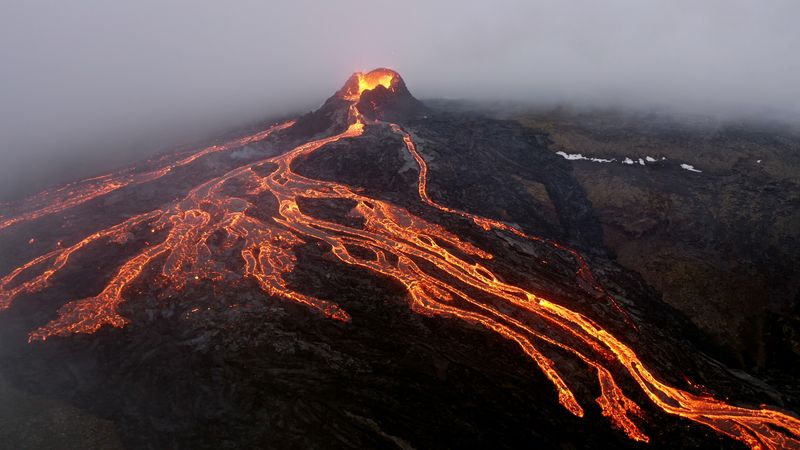
As far as they know silver and especially gold are what drive volcanoes, especially in summer, so for them there is no distinction between geology and meteorology.
Volcanoes spill much gold, less silver but also ordinary lava.
Usually the waxing and waning of the gold and silver is gentle, but sometimes it is so sudden that the ground shakes,
so Yen has earthquakes too.
Fortunately, like on Earth, they are rare.
Seasons
There is no astronomical phenomenon like a planetary axial tilt or elliptic orbit on Yen to create seasons.
Instead, these are geological, caused by upwelling and sinking of gold and silver under the surface.
When gold moves upwards it warms all of Yen and creates a Summer season.
Regional differences continue to exist, but the average temperature rises.
Some gold may flow to the very surface or burst out into the sky, so volcanic activity too is seasonal on Yen.
When the gold pressure subsides, summer is replaced by winter.
The whole warm-cold cycle, defining a year, has a very clear length of 10 months.
Spring and Autumn last about two months; Summer and Winter three.
However, both timing and strength of the gold upwelling vary from year to year.
Silver upwelling is not cyclic but irregular.
Periods of plentiful or scarce silver can last days or weeks, in rare cases months.
On the whole the supply is bountiful.
Climate, weather, ecology
On Yen, gold has a large influence on temperature and silver on humidity, but normal earth processes are at work too.
Warm air rises up from very warm areas like Nkala, Techlaltho, the Wirrah swamp
and to a lesser degree from only warm areas such as Yamazui, the Hurannar highlands, Hashi, Shihoshi, the south of the Tuarantu desert and Edyrne.
From there it flows at high altitude towards colder regions, cools, comes down and flows back low against the ground from the cold to the warm regions.
This effect is most extreme at the border between warm Nkala and cold Hardanger, where fierce winds roll down the mountains, causing trees to grow crooked, bending northwest.
The land is at its warmest in the summer, so then the winds are at their strongest too and may reach storm strength.
However, winds are fickle and sometimes weaken or grow stronger, or even change direction, so the general wind layout describes dominant, not absolute patterns.
Winter is a season of relative calm in the air.
Water evaporates from the Umi, clouds drift inland and bring rain, or in case of Taimur snow.
Most these clouds flow towards regions that are warmer than the ocean, but silver plays a role to drawing in moisture even if the winds are not favorable.
This is partly hampered by mountains, which just as on Earth act as barriers.
Part of the relative dryness of the Huranannr highlands and the Yrgiz steppes is explained by the ring of mountains that surrounds them.
The role of gold and silver is most visible in the northwest and southeast.
The Tuarantu desert and Koh are dry because of lack of silver, even in South Tuarantu where gold makes the temperature high enough to draw in wind from the Umi in the west.
Taimur is another anomaly, so cold that the low altitude winds blow away from the region.
Here it is humid air coming down from above that brings snow.
Lightning occurs most in areas where warm and cold air mix.
Again the Nkala-Hardanger borer is (in)famous for having the most frequent and most violent lightning storms, especially in summer.
Other electromagnetic phenomena that occur on Earth, such as a plaent-wide magnetic field with a north-south orientation, or the Aurora borealis/australis, are absent from Yen.
Astronomy
Suns, day, night
The world of Yen is orbited by three celestial bodies. These can be considered suns as they appear as discs in the sky that emit light. They appear a little smaller in the sky than Earth's sun and moon. Yen does not orbit any of them, instead the suns orbit Yen, which is the center of the quartet.
- Yai is white in color and orbits the closest and fastest. One orbit of Yai is called a day on Yen.
- Tsuki is purple/plum in color and orbits further out, 12 times slower than Yai.
- Taisku is light green in color and orbits the farthest, 18 times slower than Yai.
Days and nights are orchestrated by Yai, which is by far the brightest of the three.
Tsuki and Taisku provide light that is about as strong as moonlight on Earth.
However, they do not reflect light but emit it, so they are suns as well, not moons.
Days and nights have a fixed length.
All are equally long.
There is neither dependence on latitude nor seasonal variation.
Timekeeping
Though all three satellites of Yen are suns, for the purpose of timekeeping only Tai defines days; the other two define months.
A Tsuki-month is 12 days long, a Taisku-month 18 days.
A complete month spans 36 days: two full rotations of Taisku equaling three of Tsuki.
The common divider of the two months is 6 days, which is the length of a week on Yen, so there are 6 weeks in a month.
As explained above, a year on Yen is not defined by astronomy but geology, the upwelling and sinking of gold and silver.
However, there seems to be a relationship between the two, as a geological year is exactly 10 astronomical months.
Sun and moon
Yai is the brightest of Yen's three suns, so can be called 'the' sun.
Magic that works with sunlight evokes the white light of Yai.
Lycanthropy is affected by the other two suns, either Tsuki or Taisku, but not both.
These suns do not have prolonged phases like Earth's moon; when one passes in front of another such a pass is brief:
Yai passes both Tsuki and Taisku in less than 2 minutes; Tsuki passes Taisku in ¾ of an hour.
Lycanthropy is not triggered by a full moon / sun.
Instead, it is activated when one of these moons is high up in the sky, at or near the zenith.
For Tsuki this lasts 2 days out of 12, for Taisku 3 days out of 18.
Angles relative to horizon of the two outer suns at noon on all 36 days of a full month:
| Day | Tsuki | Taisku |
| 1 | 90 | 90 |
| 2 | 120 | 110 |
| 3 | 150 | 130 |
| 4 | 180 | 150 |
| 5 | 210 | 170 |
| 6 | 240 | 190 |
| 7 | 270 | 210 |
| 8 | 300 | 230 |
| 9 | 330 | 250 |
| Day | Tsuki | Taisku |
| 10 | 0 | 270 |
| 11 | 30 | 290 |
| 12 | 60 | 310 |
| 13 | 90 | 330 |
| 14 | 120 | 350 |
| 15 | 150 | 10 |
| 16 | 180 | 30 |
| 17 | 210 | 50 |
| 18 | 240 | 70 |
| Day | Tsuki | Taisku |
| 19 | 270 | 90 |
| 20 | 300 | 110 |
| 21 | 330 | 130 |
| 22 | 0 | 150 |
| 23 | 30 | 170 |
| 24 | 60 | 190 |
| 25 | 90 | 210 |
| 26 | 120 | 230 |
| 27 | 150 | 250 |
| Day | Tsuki | Taisku |
| 28 | 180 | 270 |
| 29 | 210 | 290 |
| 30 | 240 | 310 |
| 31 | 270 | 313 |
| 32 | 300 | 350 |
| 33 | 330 | 10 |
| 34 | 0 | 30 |
| 35 | 30 | 50 |
| 36 | 60 | 70 |
Tides
All three suns have an effect on the tides. The mixed triple sunrises and sunsets create a complex pattern. However, their overall pull on Yen is rather weak, so tides are mild.
Stars
Yen has stars in the sky but does not rotate, so the stars maintain fixed positions all the time. There is no separate Northern and Southern Hemisphere. Like on Earth, scattering of the light of Yai during daytime outshines all stars. During nighttime, they become visible again as Tsuki and Taisku are less bright.
Meteors and meteorites
Astronomers on Yen have never observed any meteor flying through the sky. Likewise, there is no record of any meteorite slamming into the ground, or the Umi.